Interview with Dr. Ian Paul
In anticipation of the KEDS Spring Research Seminar, we spoke with Dr. Ian Paul about his forthcoming presentation.
Can you briefly introduce yourself and describe your main area of work or research?
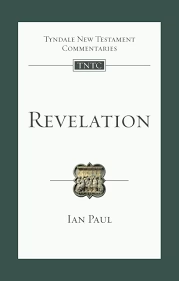
I am ordained in the Church of England, and have always sought to combine pastoral ministry and application in discipleship and the local church with my academic work. Academically, I am a member of the British New Testament Society and the Society of Biblical Literature (in the US); I lead the Tyndale New Testament group, and am part of two other research groups on the Book of Revelation.
I am research active on the Book of Revelation, currently working on issues around material culture, Revelation’s use of the Old Testament, and its narrative structure and eschatology.
What will your session focus on?
The session will be exploring one specific aspect of material culture which is important background for reading Revelation 13. When people read about the animated statue in that chapter, they either think it is a prediction of some amazing future technology, or they think it is just hyperbole. In fact, automata (or what we might call ‘robots’) were a recognised part of cult practices in the ancient world. What many people find surprising is the level of sophistication of these mechanisms—do a quick search for the Anitkythera Mechanism for an eye-opener—but they highlight a common theme in religious devotion and imperial power. Human rulers have always sought to use technology to impress the masses with their power, and used this to reinforce the sense of their legitimacy and to suppress dissent.
What first sparked your interest in this topic or area of study?
My background before theology was in mathematics and the sciences, so I have always been interested in the way that we perceive the world in these terms. Most people find Revelation a ‘strange’ text, and there are many reasons for that—its use of the Old Testament, its unusual form of language, its disturbing imagery. But one main reason is our cultural distance from the world in which it was written. Exploring the reality of life in the first century suddenly makes Revelation seem less strange, and when we recognise common patterns of human experience, it allows Revelation to speak to our world in a compelling way.
Why do you think this topic matters to the church, the academy, or the wider world today?
The Church in the West has struggled to know how to engage the unchanging gospel with the rapid changes in our culture. Revelation is a worked example of how the gospel speaks to its culture, and the ideology that shapes it, and our avoidance of this text has weakened our own engagement with our world. In particular, we are currently seeing how power, money, and technology combine together to challenge the claims of Jesus and the gospel. Understanding how Revelation engages with these questions can equip us to think about our own culture.
What question, idea, or problem has most shaped your work in this area so far?
To open the Bible is to go on a cross-cultural journey; scripture is written for us, but it is not (in the first place) written to us. We need to exercise disciplined imaginations in all our reading of Scripture, to put ourselves in the place of the first hearers of these texts, to hear them as they would have heard them. When we do this, not only do we realise how connected we are with these people, we also find the Scriptures coming alive in a fresh way. When I have spoken about this before, people find it quite fascinating!
How has your research or practice changed the way you think, teach, or minister?
In our preaching and ministry, we sometimes are tempted to think that the ‘academic’ questions of how to read the Bible are too difficult for ‘ordinary’ believers. The danger is then that we end up pulling a devotional rabbit out of the hermeneutical hat, and we fail to equip those we minister to to engage with questions for themselves. But if we show our working, then it can demystify this process and equip people to read Scripture well for themselves.
What is the one insight from your work that you hope others will find helpful or challenging?
The challenge: sometimes, doing the work to read scripture well can stretch us, and challenge our presuppositions. But the hope is that Scripture comes alive in new ways, and God can speak to us through it even to our most modern concerns.
Thank you for your time, Dr. Paul! You can sign up to Dr. Paul’s presentation on Monday 23rd February 2026 via Eventbrite
You can read more about Dr. Paul’s work at https://www.psephizo.com/