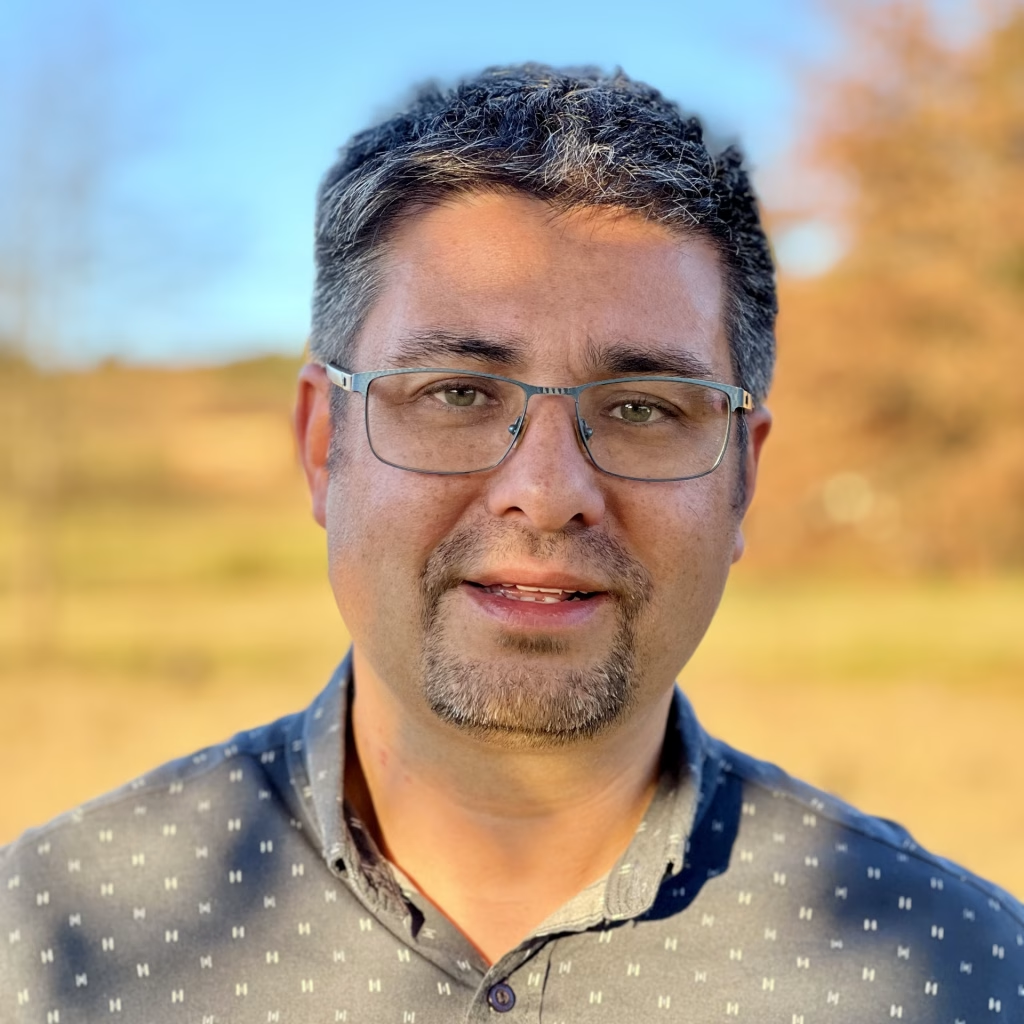
Interview with Salvador Ung Hayworth
- Posted by Aaron Kelley
- Categories Blog, Interview
- Date 27 February 2026
In anticipation of the KEDS Spring Research Seminar, we spoke with Salvador Ung Hayworth about his forthcoming presentation.
Can you briefly introduce yourself and describe your main area of work or research?
My name is Salvador Ung Hayworth. I am a voluntary pastor of Kokstad Family Evangelical Fellowship in Kokstad, KwaZulu Natal, South Africa. I am also doing my PhD with the University of Pretoria in Old Testament (though it has got a strong element of systematic theology so I have two supervisors). The PhD thesis builds on my master’s and is titled “Harmonising continuity with discontinuity: Israel’s relationship to the Ecclesia through Old Testament Exegesis for a Systematic Debate.” It seeks to develop a mediating position between progressive covenantalism and progressive dispensationalism concerning the nature of the church’s relationship to Israel. My mediating position is currently called the triune-Israel position and this is the conclusion of the master’s thesis I am speaking about in the Spring Seminar.
What will your session focus on?
I will be sharing an overview of my master’s thesis, “Towards Demonstrating the Unity of Scripture: Israel as a Biblical Theological Theme using a Synchronic Approach to the Present Majority Canon,” with the Baptist Theological College of Southern Africa (2023). To state this in layman’s terms, I examine how the theme of Israel is one that runs through Scripture, taking the text in its final form without looking at the question of sources the biblical authors may have used. The present majority canon is the 66 books that are regarded as Scripture by evangelicals and non-evangelicals alike.
What first sparked your interest in this topic or area of study?
I have been interested for a long time in what the Bible teaches about Israel, the way the Church is connected to Israel, and how the New Testament uses the Old Testament. This has mainly been through ministry I have been involved with and through KEDS. I wrote an article which was peer-reviewed for the KEDS journal, The Evangelical Review for Theology and Politics (2015) on Jesus’ relationship to Israel as depicted in Matthew’s narratives about Jesus’ birth (Mt 1:18-2:23). In it I concluded that Jesus is presented as a perfect Israel that is identified with the nation but does not replace them. I suggested that Jesus’ relationship to Israel is central to the Church’s relationship to Israel in some way. My master’s thesis develops the church’s relationship to Israel by looking at what Scripture teaches about Israel throughout the whole Bible.
Why do you think this topic matters to the church, the academy, or the wider world today?
The way the Church relates to Israel is central to how we read the Old Testament. There are many believers who don’t read through the Old Testament as a whole. In 1999, Sidney Greidanus claimed that one could reasonably conclude that less than 20% of sermons the common church member hears would be from an Old Testament text. Yet the Old Testament makes up three quarters of the Bible. Israel’s relationship to the Church is also important as supersessionism (the idea that the Church has replaced national Israel as God’s people) has been a major contributing factor to the historic treatment of Jewish people. The topic is also important for other branches of theology such as eschatology, one’s understanding of the covenants, and God’s faithfulness to His promises.
What question, idea, or problem has most shaped your work in this area so far?
How do we allow the Old Testament to shape our doctrinal commitments and apply it to our lives as Gentile believers in Jesus? How does the Old Testament contribute to our understanding to the New Testament and the way the Apostles employed the Old Testament?
How has your research or practice changed the way you think, teach, or minister?
I try to teach from the Old Testament and the New. When the New Testament quotes from the Old Testament, I get the congregation to go into the context of the Old Testament text and to see how that can inform our understanding of the New Testament message.
What is the one insight from your work that you hope others will find helpful or challenging?
Our commitment to Scripture and the interpretation of Scripture in context should be greater than our commitment to our theological categories. It is not about negating our theological commitments but allowing Scripture to change, nuance or even deepen our theological commitments as Scripture is allowed to speak within its own frame of reference.
Thank you for your time, Salvador! You can sign up to Salvador’s presentation on Monday, 2nd March 2026, via Eventbrite.
You can read more about Salvador’s work by clicking here.